
If you grew up without much money, you’ve probably heard people say “poverty is a mindset.”
That phrase can feel a bit insulting when you’re the one who’s struggled. It’s not that simple, poverty is real, and circumstances are real. Some people are dealt a much harder hand than others.
But history is full of people who started with next to nothing and built something extraordinary.
Here in Australia, Sir Frank Lowy arrived in Sydney in 1952 as a Holocaust survivor with barely a word of English and one suitcase to his name, and went on to build Westfield into a global shopping centre empire.
J.K. Rowling was a single mother relying on welfare payments while she wrote the book that would become Harry Potter. None of them started with money, connections, or an easy path. What they had in common was what they did next.
But here’s the part that gets missed: while you can’t always choose your circumstances, you can always choose your response to them. And that choice, made over and over, is what actually breaks the cycle.
This isn’t a self-improvement article. It’s about something more specific, the first mental shift that has to happen before anything else changes: understanding that between what happens to you and what you do next, there’s a gap. And in that gap is where your future gets decided.
Circumstance: What You Didn’t Choose
Nobody chooses the family, suburb, or bank balance they’re born into. If money was tight growing up, if bills caused stress in your house, if nobody sat you down and explained how credit scores or savings or property worked, none of that was your fault.
This matters because a lot of people carry guilt or shame about where they started, and that guilt can keep them stuck. The first thing to get straight is this: your starting circumstances are not a verdict on your worth or your future. They’re just the starting point.
Choice: The Part That’s Actually Yours
Between something happening to you and how you react, there’s a gap, even if it’s only a split second. In that gap is where you decide what happens next.
Tom Hopkins, one of the most widely read authors on sales and personal achievement, built a simple formula around exactly this idea: S-P-R, Stimulus, Pause, Response. Something happens (the stimulus). You take a beat before reacting (the pause). Then you choose what you do next (the response). Hopkins taught this to salespeople so they wouldn’t react on autopilot in high-pressure moments, but the same formula applies to money, to family patterns, to any circumstance you didn’t choose. The pause is where your power lives. Skip it, and you just repeat whatever reaction you were conditioned into. Use it, and you get to choose something better.
This is the part a lot of self-improvement thinking gets right, even if it’s often wrapped in hype. Circumstances don’t determine your life, decisions do. Not one big decision either. Small, boring, repeated decisions: whether you open the bill or ignore it, whether you ask for help or pretend everything’s fine, whether you put $20 away or spend it, whether you show up to work on the hard days or call in sick because it’s easier.
None of these choices feel dramatic in the moment. That’s exactly why they’re so powerful, they’re not asking you to become a different person overnight. They’re asking you to make one slightly better decision than you would have automatically made, right now, today.
This is also where a lot of people get stuck without realising it. If you grew up watching the adults around you react to hardship with resignation, “that’s just how it is for people like us”, you can absorb that as truth without ever questioning it. Breaking the cycle starts with noticing that belief and asking: is that actually true, or is that just what I was shown?
Opportunity: What Choice Opens Up
Here’s the part that’s easy to miss. Opportunities aren’t handed out randomly. They tend to show up after a choice, not before it.
The person who chooses to ask their bank a question they’re embarrassed to ask ends up understanding their options better than the person who avoids the conversation out of fear. The person who chooses to track their spending for one month, even badly, starts seeing patterns they never noticed. The person who chooses to have an uncomfortable conversation about money with their partner opens the door to actually planning together instead of guessing.
None of these choices guarantee an outcome. But they’re what put you in the room where opportunity can actually reach you. You can’t spot an opportunity you’ve never positioned yourself to see.
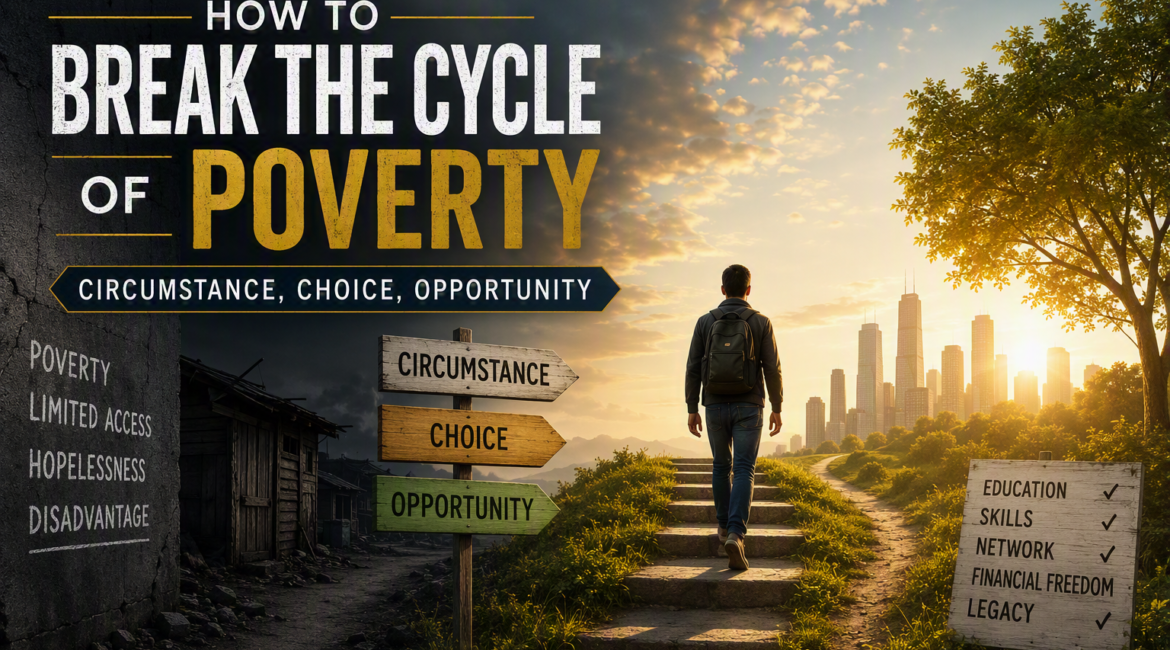
This is the pattern worth remembering: circumstance, choice, opportunity. Circumstance is where you start. Choice is what you control. Opportunity is what choice makes possible, not guaranteed, but possible. And possible is a lot further than most people ever let themselves get.
What This Looks Like in Real Life
This isn’t abstract. In lending and finance, we see this pattern play out constantly.
Two people can start in almost identical circumstances, same income, same suburb, same family background. Five years later, one owns a home and the other doesn’t. The difference is rarely luck. It’s usually a string of small choices: one person started asking questions about their borrowing power earlier, kept a savings habit going even when it was only $50 a fortnight, or picked up the phone when something felt uncertain instead of avoiding it.
The other person wasn’t lazy or less deserving. They just never got the moment where someone said, “your choices from here are yours, even if your starting point wasn’t.”
That’s the whole point of this article. If you’re reading this and your circumstances have felt unfair, they probably have been. That’s real. But the cycle doesn’t break because circumstances suddenly become fair. It breaks the moment you decide that your next choice is yours to make, and you make it anyway.
5 Books to Help You Shift Your Mindset
If you want to keep building on this idea, these five books are a great place to start:
- The Barefoot Investor by Scott Pape, a practical, no-nonsense guide to getting your money sorted, written specifically for Australians.
- How to Master the Art of Selling by Tom Hopkins, the book behind the Stimulus, Pause, Response idea covered above, and a masterclass in taking control of how you respond to pressure.
- The Alchemist by Paulo Coelho, a short, simple story about listening to what you actually want and having the courage to chase it.
- The Richest Man in Babylon by George S. Clason, timeless lessons on saving and building wealth, told through simple parables.
- Think and Grow Rich by Napoleon Hill, one of the original books on how mindset and persistence shape financial outcomes.
If this hit home and you’re ready to put it into action, here’s where to start. If you’re raising kids on your own, our Single Parent Home Loans page walks through the government-backed scheme that can get you into a home with as little as a 2% deposit.
And if this will be your first home, our First Home Buyer Loans page breaks down exactly what you need to know about deposits, borrowing power, and the schemes available to you.
If you’re ready to turn a change in mindset into an actual plan, savings, borrowing power, or your first step toward owning a home, that’s exactly the conversation we’re here for.