Not all debt is created equal. Some debt can help you build wealth over time. Other debt can hold you back for years. Understanding the difference between “good debt” and “bad debt” can help you make smarter money decisions. Here’s a simple guide.
What is good debt?
Good debt is usually money borrowed to buy something that:
- Is likely to grow in value, or
- Produces income, or
- Improves your long-term earning power
Examples of good debt
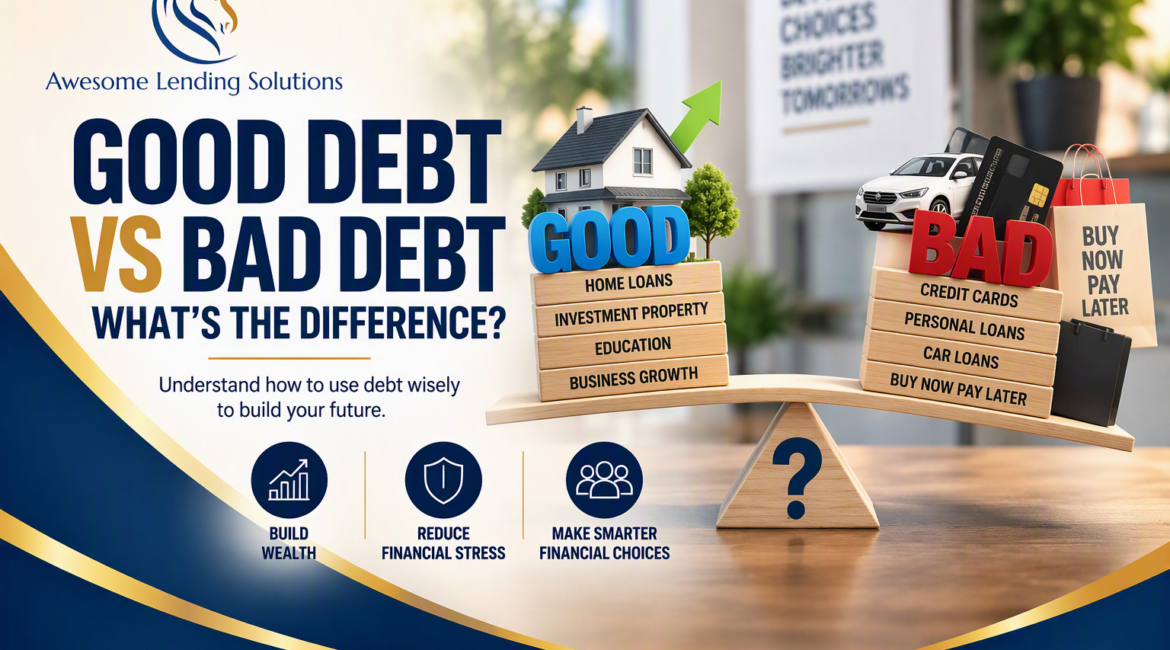
- A home loan – your home may grow in value over time, and you stop paying rent
- An investment property loan – the property may grow in value and earns rent
- Some education debt – like HECS-HELP, which can increase your earning potential
- Business loans – used to grow a profitable business
Good debt usually has a lower interest rate and may have tax benefits, such as deductible interest on investment loans.
What is bad debt?
Bad debt is usually money borrowed to buy things that:
- Lose value quickly
- Don’t produce income
- Are consumed straight away
Examples of bad debt
- Credit card debt – often at 20% or more
- Personal loans for holidays or lifestyle spending
- Car loans – cars lose value quickly
- Buy Now Pay Later – easy to overuse
- Payday loans – very expensive
Bad debt often has high interest rates and no tax benefits.
It’s not always black and white
- A car loan might be necessary if you need a car to get to work.
- Good debt can become bad debt if you borrow too much or can’t afford the repayments.
- Investment debt can turn sour if the investment performs poorly or rates rise sharply.
The key question is: does this debt help me build wealth, and can I comfortably afford it?
Why it matters for home buyers
Bad debt reduces your borrowing power. Lenders count:
- Credit card limits, not balances
- Car loan and personal loan repayments
- BNPL accounts
- HECS-HELP repayments
Paying off bad debt before applying for a home loan can significantly increase how much you can borrow.
How the 2026 tax changes affect “good” investment debt
Investment debt has long been seen as good debt partly because of negative gearing. Under the 2026 laws, for established residential properties bought after 7:30pm on 12 May 2026, rental losses can only be offset against residential rental income or capital gains from 1 July 2027. New builds and properties held before the cut-off keep the existing treatment. This doesn’t make investment debt bad, but it means cash flow matters more.
Strategies for managing debt
1. Pay off bad debt first
Start with the highest interest rate (the “avalanche” method) or the smallest balance (the “snowball” method).
2. Avoid new bad debt
Use a debit card, save for purchases, and avoid BNPL.
3. Pay down non-deductible debt before deductible debt
If you have both a home loan and an investment loan, it often makes sense to pay down the home loan first, because its interest isn’t deductible.
4. Use an offset account
Keep savings in offset to reduce home loan interest while keeping funds available.
5. Consider consolidation carefully
Rolling bad debt into your home loan can lower the rate, but pay it off quickly so it doesn’t become long-term debt.
An example
Sam has:
- A $450,000 home loan at 6.2%
- A $12,000 credit card at 20%
- A $20,000 car loan at 9%
He pays off the credit card first, then the car loan, while making normal home loan repayments. Within two years, his bad debt is gone and his borrowing power has improved enough to consider an investment property.
Debt in a rising rate year
With the cash rate at 4.60% after four rises in 2026, all debt costs more. That makes clearing high-interest bad debt even more valuable. Every dollar of credit card debt you clear saves far more interest than the same dollar left in savings.
A quick debt check
List every debt with its balance, rate and purpose. Mark each one as good or bad, then make a plan to clear the bad debts first.
Frequently asked questions
Is a home loan good debt?
Generally, yes, as long as you can comfortably afford it.
Is HECS-HELP bad debt?
It’s usually considered good debt, but it does reduce borrowing power.
Should I pay off debt or save for a deposit?
Often both. Clearing high-interest debt first usually makes sense.
Is investment debt always good?
Not always. It depends on the investment, your cash flow and the risks.
Talk to Awesome Lending Solutions
Every situation is different, and the right loan depends on your goals, income and timing. At Awesome Lending Solutions, we compare a wide panel of lenders and explain your options in plain English, with no pressure. Call us on 02 7904 9560 or visit awesomelendingsolutions.com.au to book a chat.
This article is general information only. It does not consider your objectives, financial situation or needs, and it is not financial, tax or legal advice. Scheme rules, interest rates and laws were current as at October 2026 and can change. Speak with a licensed professional before making any decision. Albert Waldron is a Credit Representative (CR 407514) of AFG’s Australian Credit Licence 389087.