
First Home Buyer Roadmap: 8 Steps From Saving to Settlement
Buying your first home can feel like a lot. There are forms, schemes, deadlines and a lot of advice from people who bought 20 years ago. This roadmap breaks it into 8 clear steps, in the order they usually happen.
Print the roadmap below, stick it on the fridge, and tick off each step as you go. If you get stuck at any point, give us a call. We do this every week.
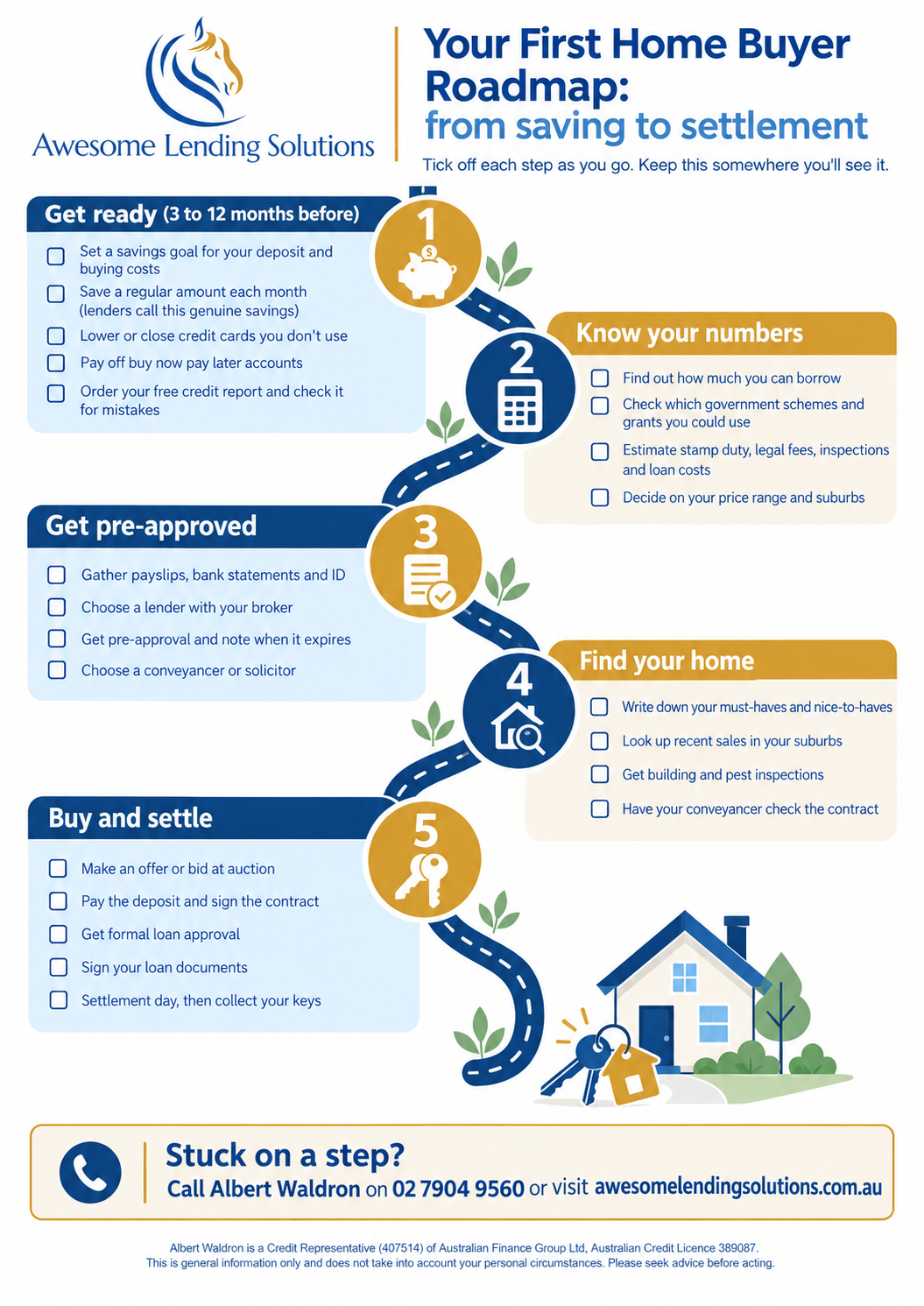
Click the roadmap to open the full-size version to print.
Step 1: Get Credit Ready
Before you look at a single property, find out what a lender will see when they look at you. Lenders judge every application on four things, often called the 4Cs of credit:
- Character: your credit history and how you have handled bills and debts
- Capacity: whether your income can cover the repayments, with room to spare
- Capital: your savings and deposit, and how you built them
- Conditions: the lender rules and the market at the time you apply
Start by getting a free copy of your credit report and fixing any errors. Pay down or close credit cards you don’t use, because lenders count the full limit, not just what you owe.
Want to know how you score? Read our Credit Ready guide to the 4Cs.
Step 2: Work out your deposit and which schemes fit
You may need less than you think. The old rule of saving 20% still works, but it isn’t the only way in.
- 5% deposit: through the Australian Government 5% Deposit Scheme, with no Lenders Mortgage Insurance (LMI). There are no income caps or limits on places, but there are price caps by area.
- 2% deposit: for eligible single parents and legal guardians. See home loans for single parents.
- Family help: a parent can use equity in their home to guarantee part of your loan. See guarantor home loans.
- Save 10% or more: you may pay some LMI, but you have more lender choice.
Read the 5% Deposit Scheme explained or how much deposit do I need?
Step 3: Add up the full cost of buying
The deposit is only part of it. Make sure you have money set aside for:
- Stamp duty: many first home buyers pay little or none. Check stamp duty concessions by state.
- Legal and conveyancing fees: usually a few thousand dollars
- Building and pest inspections, plus a strata report if you’re buying a unit
- Moving costs and a buffer for anything that pops up
On the plus side, if you’re buying or building a new home, you may get a grant. See the First Home Owner Grant by state.
Step 4: Get pre-approval
Pre-approval tells you how much a lender is likely to lend you, so you can shop with confidence. It usually lasts 3 to 6 months.
When lenders work out your borrowing power, they test whether you could still afford the loan if rates went up. Banks generally add 3% to the rate. Some non-bank lenders use a smaller buffer, which can mean a higher limit. This is one reason the lender you choose matters so much.
Have these ready: ID, recent payslips, bank statements showing your savings, and details of any debts. If you’re self-employed, you’ll usually need tax returns too. See self-employed home loans.
Step 5: Find the right property
Now the fun part. Keep these in mind while you look:
- Stay under your pre-approved amount, and under the scheme price cap if you’re using one
- Look at the location, not just the house. Transport, schools and future plans for the area all matter.
- Get a building and pest inspection before you commit
- For units, read the strata report. Check the sinking fund and any big repairs coming up.
Step 6: Make an offer or bid at auction
If you buy by private sale, you make an offer and negotiate. In NSW, private sales usually come with a 5 business day cooling-off period, so you have a short window to finish your checks.
Auctions are different. There is no cooling-off period, and when the hammer falls the property is yours. Have your finance, inspections and contract review done before auction day.
Rules differ between states, so ask your conveyancer what applies to you.
Step 7: Formal approval and scheme paperwork
Once your offer is accepted, we send the full application to the lender for formal approval. The lender will usually order a valuation of the property.
This is also when the scheme and grant forms are lodged. These forms confuse a lot of people, and small mistakes cause delays. We help you complete and submit them through your lender, and Myra from our team reviews every form before it’s sent, to avoid delays and rejections.
Step 8: Settlement and moving in
Settlement is the day the money changes hands and you get the keys. It is often about 6 weeks after you sign, but it can be shorter or longer.
Before settlement, do a final inspection, set up your home and contents insurance, and arrange your utilities. Then move in and enjoy it.
One last tip: don’t set and forget your loan. Rates change and lenders compete for new customers. A yearly review can save you thousands. See home loan refinancing.
Real example: Sally and Peter
Sally and Peter (not their real names) had rented the same unit in Sydney’s Inner West for 10 years. When the owner decided to sell, they wanted to buy it.
- Price: $750,000
- Incomes: Sally earns $90,000 as an employee. Peter earns $120,000 and was in his second year of self-employment.
- Deposit: 5%, using the 5% Deposit Scheme, so no LMI
The tricky part was Peter’s income. Many lenders want two full years of tax returns and treat newer businesses with caution. We found a participating lender that assessed his business income properly, got them pre-approved, and handled the scheme forms. Myra checked everything before it went in, and the loan went through without delays.
After a decade of paying someone else’s mortgage, they now own the home they already loved.
Common mistakes to avoid
- Taking on new debt, like a car loan or buy now pay later, while you’re applying
- Changing jobs just before you apply, without talking to us first
- Paying for a property before your finance is approved
- Forgetting stamp duty and other costs in your budget
- Assuming you don’t qualify for a scheme without checking
Questions first home buyers ask
How long does it take to buy a first home?
Once you have your deposit, many buyers go from pre-approval to settlement in 2 to 4 months. Finding the right property is usually the longest part.
Can I buy with a 5% deposit?
Yes, if you’re eligible for the 5% Deposit Scheme and the property is under the price cap for the area.
Do I need a broker?
You don’t have to use one, but a broker can compare many lenders, which matters most when your situation isn’t simple. Our service is usually free to you, because the lender pays us.
Where do I start?
Step 1. Call us and we’ll tell you where you stand and what to do next.
Ready to start? Talk to us today
Fill in the form and we’ll call you back, or call us on 02 7904 9560.
Keep going
- First home buyer checklist: every document you will need
- Prices by state: what you can afford where you live
Albert Waldron is a Credit Representative (407514) of Australian Finance Group Ltd, Australian Credit Licence 389087. This is general information only and does not take into account your personal circumstances. Please seek advice before acting. Government schemes, grants and stamp duty rules can change; eligibility is confirmed by the lender and the relevant government body.